Ontario is the only province where paralegal education is regulated. You must graduate from a Law Society of Ontario accredited program to be licensed. No other province licenses paralegals, so employers and tribunals set their own requirements. British Columbia is building a regulated paralegal category, but not before 2028.
Where you plan to work decides what you need to study. Ontario runs an accreditation system with legal force behind it, and a program that isn’t on the Law Society’s list won’t get you licensed no matter how good it is. Everywhere else in Canada, the same program is one credential among several that an employer may or may not ask for.
That split shapes every decision you’ll make about paralegal school in Canada, from what a program costs to whether it leads to independent practice. British Columbia is the one province in motion. Its Legal Professions Act survived a constitutional challenge in April 2026 and will eventually create a second regulated paralegal category, though the new regulator isn’t due to take over until 2028.
This guide covers accredited programs in Ontario, what’s available in the rest of the country, what training costs, and what the wage and hiring data actually shows. If you’re weighing the career itself rather than the schooling, start with our guide to becoming a paralegal in Canada.


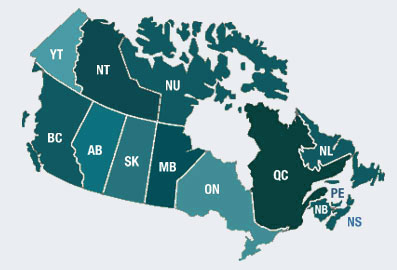
Paralegal Programs by Province in Canada
British Columbia
Manitoba
New Brunswick
Newfoundland and Labrador
Nova Scotia
Ontario
Prince Edward Island
Quebec
Saskatchewan
Northwest Territories
Nunavut
Yukon Territory
Ontario’s Unique Licensing System
Ontario established paralegal regulation in 2007 through the Law Society of Ontario (LSO), known as the Law Society of Upper Canada until the name changed in 2018. It remains the only Canadian jurisdiction where paralegals must be licensed and can practice independently.
Licensed Ontario paralegals are officers of the court with authority to represent clients in specific legal matters. That sets them apart from paralegals elsewhere in Canada, who work under lawyer supervision and can’t provide independent legal services.
What Licensed Ontario Paralegals Can Do
The LSO license grants authority to practice independently in four areas:
- Small Claims Court, for civil disputes up to $50,000. The limit rose from $35,000 on October 1, 2025 under Ontario Regulation 42/25, and the threshold for appealing a Small Claims decision rose from $3,500 to $5,000 at the same time.
- Provincial Offences Court, covering traffic tickets and municipal bylaw violations.
- Certain Criminal Code summary conviction matters. This isn’t every offence that currently carries a six-month maximum. The LSO maintains a defined list of permitted summary conviction offences for regulated agents, and that list is what governs.
- Administrative tribunals, including the Landlord and Tenant Board, the Workplace Safety and Insurance Board, and the Human Rights Tribunal of Ontario.
A fifth area opened recently. The LSO created the Family Legal Services Provider (FLSP) authorization, which lets qualified paralegals handle a defined slice of family law: process navigation, joint and uncontested divorces, straightforward motions to change child support, and change of name applications. The FLSP is not a separate license. It’s an add-on to an existing P1 paralegal licence, and earning it means completing the FLSP certificate program at Fanshawe College, passing the LSO’s FLSP examination, and applying for authorization. The first cohort started in January 2025 and the program is running now. The LSO publishes a public directory of authorized FLSPs.
Licensing Requirements
To become a licensed paralegal in Ontario, you must:
- Graduate from an LSO-accredited paralegal education program. For students entering a program on or after September 1, 2024, accredited programs must include at least 240 hours of field placement. The earlier 120-hour minimum applies only to cohorts that started before that date.
- Pass the Paralegal Licensing Examination.
- Meet the good character requirement under the Law Society Act.
- Complete every requirement inside a three-year licensing term.
The licensing exam, often called the P1, is a self-study, open-book, multiple-choice paper of 160 questions written in 4 hours and 30 minutes, in English or French. It’s scored pass or fail against an entry-level competence standard rather than a published percentage. Candidates get three attempts within their licensing term, or four with authorization. Sittings run three times a licensing year, in summer, fall, and winter.
Costs have moved. The exam fee rose to $1,460 for the 2026-27 licensing year, up from $1,075. Once licensed, paralegals pay an annual fee of $1,037 for 2026, which nets to $1,007 after a $30 refund from the paralegal Compensation Fund, and complete 12 hours of continuing professional development each year.
Provincial Requirements Across Canada
Outside Ontario, no province currently regulates paralegals directly. That produces a clear divide in how the job works from one jurisdiction to the next.
| Province | Licensing Required | Independent Practice | Regulatory Status |
|---|---|---|---|
| Ontario | Yes | Yes | Fully regulated by the LSO since 2007 |
| British Columbia | Not yet | Not yet | Legal Professions Act upheld in April 2026, new regulator targeted for January 2028 |
| Alberta | No | No | Unregulated, advocacy ongoing |
| All other provinces and territories | No | No | Unregulated, qualifications set by employers |
British Columbia’s Shift Toward Regulated Paralegals
British Columbia’s Legal Professions Act received Royal Assent in May 2024. It replaces the Law Society of British Columbia with a single regulator, Legal Professions British Columbia, covering lawyers, notaries, and a new category the Act calls a regulated paralegal.
The Law Society of BC and the Trial Lawyers Association of BC challenged the Act’s constitutionality. Their summary trial was heard in October 2025, and on April 29, 2026 the BC Supreme Court dismissed both claims and upheld the legislation. Chief Justice Ronald Skolrood accepted that the independence of the bar is an underlying constitutional principle but found the new regulatory scheme didn’t offend it. Both organizations filed notices of appeal in early May 2026, so the litigation isn’t finished.
Implementation is running on a longer clock than earlier coverage suggested. The transitional board, Indigenous council, and advisory committee are working toward an amalgamation date of January 1, 2028, with public consultation on the new regulator’s rules planned for January 2027. Legal Professions BC struck a paralegal committee in April 2026 to develop licensing requirements. What a regulated paralegal will actually be allowed to do is still open: a provincial working group closed its public consultation on scope of practice in February 2026, and the scope will be set by regulation once the Attorney General acts on its recommendations.
For anyone choosing a program today, the practical reading is that BC has no paralegal license to prepare for, and won’t have one before 2028 at the earliest.
Current Requirements in Unregulated Provinces
Where there’s no licensing system, employers set the bar. Job postings ask for a wide range:
- Certificate programs, typically 6 to 12 months
- Diploma programs, typically 2 years
- Bachelor’s degrees in paralegal studies or a related field
- No formal education at all, with training on the job
BC adds one wrinkle worth knowing. The Law Society there allows a lawyer to supervise up to two designated paralegals, who may give legal advice and, where a tribunal permits it, appear before it. A designated paralegal is a supervised employee, not an independent contractor, and courts generally don’t permit these appearances. Note also that “independent paralegal” appears in Statistics Canada’s occupational grouping as a labor-market label. It isn’t a license, and it grants no authority to practice law on your own in BC.
The Canadian Association of Paralegals recommends contacting employers before you choose a program, since standards vary widely between firms and practice areas.
Education Programs and Pathways
Your education path depends on where you plan to practice and what you’ve already studied.
Ontario: LSO-Accredited Programs Required
If Ontario is the goal, only an LSO-accredited program will do. The Law Society accredits programs at both public colleges of applied arts and technology and private career colleges, and every accredited program includes a mandatory field placement.
| Credential | Typical Length | Who It’s Designed For |
|---|---|---|
| Certificate | 2 to 3 years | Entry-level competence, with the lightest admission requirements |
| Diploma | 1 to 2 years | Broader skills through a mix of theory and hands-on work |
| Diploma, accelerated | 1 to 1.5 years | The same content on a compressed schedule and a heavier course load |
| Graduate Certificate | 1 to 2 years | Applicants who already hold a post-secondary credential |
| Applied Degree (Bachelor) | 4 years | The widest coverage, with advanced courses, research and longer placements |
International students pay substantially more, roughly $30,000 to $36,000 for diplomas and $15,600 to $20,558 for graduate certificates.
Treat all of these as planning ranges rather than quotes. Tuition varies by institution, intake year, ancillary fees, and residency status, and individual programs fall outside these bands in both directions. Check the school’s own fee page before you budget.
Here is every paralegal program the Law Society currently accredits, by institution, campus and credential. Several colleges appear more than once because they run the same subject at different credential levels.
| Institution | Location | Credential | Language |
|---|---|---|---|
| Algonquin Careers Academy | Ottawa | Diploma | English |
| Anderson College | Mississauga, London | Diploma | English |
| CDI College | North York, Brampton | Diploma | English |
| Centennial College | Toronto | Graduate Certificate | English |
| Centennial College | Toronto | Diploma | English |
| Cestar College of Business, Health and Technology | Toronto | Diploma | English |
| CIMT College | Brampton, Toronto | Diploma | English |
| CTS Canadian Career College | Barrie, Sudbury | Diploma | English |
| Durham College | Oshawa | Diploma | English |
| Durham College | Oshawa | Graduate Certificate | English |
| Durham College | Oshawa | Honours Bachelor of Paralegal (4-yr) | English |
| Fanshawe College | London | Graduate Certificate | English |
| George Brown Polytechnic | Toronto | Certificate | English |
| Georgian College | Barrie | Graduate Certificate | English |
| Humber Polytechnic | Toronto, North Campus | Diploma | English |
| Humber Polytechnic | Toronto, North Campus | Graduate Certificate | English |
| Humber Polytechnic | Toronto, Lakeshore Campus | Bachelor of Paralegal Studies | English |
| Collège La Cité | Ottawa | Diploma | Français |
| Loyalist College | Belleville | Diploma | English |
| Mohawk College | Hamilton | Diploma | English |
| Seneca Polytechnic | Toronto | Diploma | English |
| Seneca Polytechnic | Toronto | Certificate | English |
| Sheridan College | Brampton | Diploma | English |
| St. Clair College | Windsor | Diploma | English |
| triOS College | Brampton, Hamilton, Kitchener, London, Mississauga, Toronto | Diploma | English |
Captured from the Law Society of Ontario’s accredited programs directory in September 2026. Accreditation is added and withdrawn over time, so confirm any program against the live LSO directory before you apply.
Two institutions hold accreditation for a four-year degree: Humber Polytechnic’s Bachelor of Paralegal Studies, taught at its Lakeshore campus, and Durham College’s Honours Bachelor of Paralegal in Oshawa. Collège La Cité in Ottawa runs the only accredited program taught in French.
Other Provinces: More Flexible Options
Outside Ontario, colleges and universities offer paralegal programs with no accreditation requirement attached. Capilano University in North Vancouver runs the Bachelor of Legal Studies (Paralegal), the only paralegal bachelor’s degree in Western Canada, though BC doesn’t require any particular credential.
Certificates outside Ontario vary in length, admission requirements, and who they’re built for. Some are aimed at people who already hold a degree, others at those already working in legal support roles. Capilano’s certificate, for instance, is designed for people employed in the field who want to study part time. Check the individual program rather than assuming a standard shape.
University degrees mix paralegal coursework with general education. Some students treat them as preparation for law school, working as paralegals to build legal experience first.
Choosing the Right Program
Study in the province where you intend to work. Statutes, procedures, and court rules differ across provinces, and Ontario’s licensing requirement makes the point sharper still: an excellent program in Alberta does nothing for an Ontario license application.
If you haven’t settled on a province, talk to employers early. Their hiring requirements will tell you faster than a program brochure which credential is worth the tuition.
Salary and Career Outlook
National and Provincial Wage Data
Canadian paralegals earn a median of $33.05 an hour nationally, with the middle range running from $21.63 to $52.19. Provincial variation is wide. Job Bank publishes the wage spread but doesn’t establish how much of the gap comes from cost of living, employer mix, industry, or experience. For a fuller breakdown including major cities, see our guide to paralegal salaries in Canada.
| Province or Territory | Low ($/hour) | Median ($/hour) | High ($/hour) |
|---|---|---|---|
| Canada | $21.63 | $33.05 | $52.19 |
| British Columbia | $26.43 | $39.58 | $50.67 |
| Yukon | $30.28 | $36.61 | $54.69 |
| Alberta | $25.96 | $33.65 | $55.00 |
| Ontario | $20.71 | $33.00 | $54.95 |
| Manitoba | $21.25 | $32.72 | $67.20 |
| New Brunswick | $20.00 | $30.26 | $46.15 |
| Saskatchewan | $20.00 | $30.00 | $85.00 |
| Quebec | $20.56 | $28.57 | $45.11 |
| Nova Scotia | $17.00 | $28.21 | $42.01 |
| Newfoundland and Labrador | $18.00 | $26.01 | $37.84 |
| Prince Edward Island | $20.65 | $26.00 | $32.97 |
These are low, median, and high figures rather than percentiles, and they describe the spread of pay across the occupation, not stages of a career. The Northwest Territories and Nunavut have too few workers in the occupation for Job Bank to publish separate figures.
Pay is only part of the package. Job Bank data shows 88% of workers in this occupation receive at least one non-wage benefit, such as a pension plan, health or dental coverage, or paid leave. Job Bank reports the figure directly; comparing it against similarly paid occupations would take a separate dataset.
Job Market Outlook
The Canadian Occupational Projections System expects labor demand and supply to be broadly in balance nationally over the 2024 to 2033 period, on a base of about 36,000 workers in 2023. Balance means neither a shortage nor a surplus, so hiring should track roughly with the number of people entering and leaving the field.
Shorter-term three-year prospects vary by province:
- Good: New Brunswick and Saskatchewan
- Moderate: Prince Edward Island, Nova Scotia, Quebec, Ontario, Manitoba, Alberta, and British Columbia
- Undetermined: Newfoundland and Labrador, Yukon, the Northwest Territories, and Nunavut, where sample sizes are too small to rate
Retirement is a real driver of openings. Nationally, 31% of people in this occupation are 50 or older, and the median retirement age was 64 in 2023. Openings created by people leaving the field aren’t the same as newly created jobs, but they’re still hiring opportunities.
British Columbia offers the most detailed provincial forecast. WorkBC projects 1,670 job openings between 2025 and 2035, with average annual earnings of $70,824. Public administration accounts for about 1,300 of those forecast openings, professional, scientific and technical services for 340, and finance, insurance and real estate for 20. Read that carefully: it’s a forecast of openings in BC, not a snapshot of where Canadian paralegals work today, and BC’s occupational group is a broad one that also counts justices of the peace, notaries public, and trademark agents. Roughly three quarters of BC’s paralegal employment sits in the Mainland and Southwest region.
Professional Development and Associations
Continuing Professional Development in Ontario
Licensed Ontario paralegals complete 12 CPD hours a year, made up of at least 3 professionalism hours, of which at least 1 must address equity, diversity, and inclusion, plus up to 9 substantive law hours.
The LSO delivers CPD through workshops, seminars, and conferences, and accredits outside providers. Bar associations and paralegal organizations run qualifying programs too, increasingly online.
No other province requires CPD, because no other province regulates the profession. Voluntary training still helps with specialization and advancement, it just isn’t a condition of keeping your job.
Professional Associations
The Canadian Association of Paralegals (CAP) offers continuing education, networking, a code of ethics, and member benefits including group insurance. Membership is priced differently inside and outside Quebec: general membership runs $259.51 in Quebec and $180.25 elsewhere, student membership $25.70 and $16.43, with a reduced student-to-general transition rate for new graduates. All figures are before tax.
CAP doesn’t offer a national certification, and no such credential exists in Canada. That’s a genuine difference from the United States, where NALA and the NFPA administer voluntary national exams.
Provincial associations include:
- Ontario Paralegal Association (OPA), a large association of licensed paralegals in the province, running CPD conferences and intervening in cases that affect paralegal practice
- BC Paralegal Association (BCPA), which holds an appointed seat on the Legal Professions BC transitional board
- Alberta Association of Professional Paralegals (AAPP), a long-running advocate for regulation in that province
These groups typically run lunch-and-learn sessions, networking events, and professional development outside any regulatory requirement.
How Canada Differs from the United States
The core difference is independence. Licensed Ontario paralegals act as legal practitioners in their own right. American paralegals work under attorney supervision in every state.
| Aspect | United States | Canada (Ontario) | Canada (Other Provinces) |
|---|---|---|---|
| Independent Practice | Not permitted for paralegals in any state, though some states authorize other categories of non-lawyer legal provider | Permitted within a defined scope | Limited, no court representation |
| Court Representation | Not permitted for paralegals, though agency rules can authorize non-lawyer representation in specific proceedings | Yes, in Small Claims, POA court, tribunals, and summary matters | No |
| Licensing Required | No state licenses paralegals. California is the only state that regulates them directly, setting education and continuing education rules for anyone using the title | Mandatory through the LSO | No |
| Provide Legal Advice | Prohibited | Yes, within permitted scope | No |
Education Standards: ABA vs. LSO
The American Bar Association approves paralegal programs voluntarily. About 225 of the roughly 500 paralegal programs in the United States carry ABA approval, or about 44% by the ABA’s own count. That approval doesn’t extend to Canadian programs.
LSO accreditation works differently. It isn’t a quality mark you can do without, it’s a legal precondition for licensure. Graduating from an accredited program is required to practice in Ontario, while ABA approval in the US mainly improves a graduate’s standing with employers.
Credentials don’t cross the border in either direction. Ontario licensing grants no US practice rights, and US paralegal education doesn’t satisfy the LSO’s accreditation requirement.
Frequently Asked Questions
Do I need certification to work as a paralegal in Canada?
Only in Ontario, and there it’s a license rather than a certification. Ontario practice requires graduation from an LSO-accredited program and a passing grade on the licensing examination. In every other province and territory, qualifications are set by employers. Some want a certificate, diploma, or degree, others hire and train on the job.
Can Canadian paralegals represent clients in court?
Licensed Ontario paralegals can, in Small Claims Court for disputes up to $50,000, in Provincial Offences Court, in summary criminal matters, and before a range of administrative tribunals. Paralegals in other provinces can’t appear in court. In BC they may attend some tribunal and administrative hearings, including landlord and tenant and immigration matters, but not court.
What’s the fastest way to become a paralegal in Canada?
For Ontario, a graduate certificate takes about a year if you already hold a bachelor’s degree. Private career colleges run accelerated diplomas of 52 to 60 weeks. In provinces with no licensing requirement, some employers will hire with minimal formal education and train you. A short certificate is common among applicants, though we have no placement data showing how much it changes hiring outcomes.
How much does paralegal education cost in Canada?
For domestic students, Ontario college diplomas run about $7,000 to $11,000 in total, graduate certificates $4,500 to $6,500, and bachelor’s degrees $26,000 to $34,000 over four years. Private career college programs typically fall between $12,000 and $20,000. International tuition is much higher, often $30,000 to $36,000 for a diploma. Budget separately for licensing: the Ontario exam fee is $1,460 for 2026-27.
Can US paralegal credentials transfer to Canada?
Not automatically. For Ontario you must complete LSO-accredited education and pass Ontario’s licensing exam regardless of what you hold in the US. In provinces without licensing, US education and experience may satisfy an employer, but you’d need to confirm that firm by firm since there’s no common standard.
Is British Columbia about to require paralegal licensing?
Not soon. The BC Supreme Court upheld the Legal Professions Act on April 29, 2026, dismissing constitutional challenges from the Law Society of BC and the Trial Lawyers Association of BC. Both filed appeals in May 2026. The new regulator, Legal Professions BC, is working toward a January 2028 amalgamation date, and the scope of practice for a regulated paralegal has not been set. There is no BC paralegal license to prepare for today.
What is the Family Legal Services Provider authorization?
It’s an authorization the LSO adds to an existing P1 paralegal licence, not a separate credential. It permits a defined set of family law services including process navigation, joint and uncontested divorces, straightforward child support variations, and name changes. Getting it means completing the FLSP certificate program at Fanshawe College, passing the LSO’s FLSP examination, and applying for authorization.
What’s the difference between a paralegal certificate and a diploma in Canada?
In Ontario the labels are set by the Law Society, and they don’t match the usual assumptions. A Diploma runs 1 to 2 years. A Certificate runs 2 to 3 years and carries the lightest admission requirements. A Graduate Certificate runs 1 to 2 years and is the one built for applicants who already hold a post-secondary credential. What matters for licensing isn’t the label but whether the specific program appears in the LSO’s accredited directory.
Key Takeaways
- Ontario is the only province where paralegal education is regulated, and only graduates of LSO-accredited programs can be licensed to practice independently
- Ontario licensing requires an accredited program with a 240-hour field placement for anyone starting on or after September 1, 2024, a 160-question open-book exam written in 4 hours 30 minutes, good character, and 12 CPD hours a year, with a $1,037 annual fee for 2026
- Licensed Ontario paralegals can appear in Small Claims Court for disputes up to $50,000, a limit that rose from $35,000 in October 2025
- Every other province leaves qualifications to employers, so a certificate, diploma, degree, or on-the-job training may all be acceptable depending on the firm
- Nineteen Ontario institutions hold LSO accreditation across 25 programs, from 1-year diplomas to two four-year degrees at Humber and Durham, and only programs on that list qualify a graduate to sit the licensing exam
- Canadian paralegals earn a median of $33.05 an hour, ranging from $26.00 in Prince Edward Island to $39.58 in British Columbia, and 88% receive at least one non-wage benefit
- British Columbia’s Legal Professions Act was upheld in April 2026 and is under appeal, with a regulated paralegal category tied to a January 2028 amalgamation rather than anything imminent
- National demand and supply are expected to stay in balance through 2033, with the strongest three-year prospects in New Brunswick and Saskatchewan and retirement driving much of the hiring
Exploring Paralegal Education Options?
Whether you’re comparing accredited Ontario programs or weighing options across North America, knowing what your province requires is the first step.
Sources: National and provincial wage data from the Government of Canada Job Bank (NOC 42200, reference period 2023-2024, updated November 2025). Job prospects and long-term outlook from Job Bank and the Canadian Occupational Projections System (2024-2033). British Columbia earnings and job openings from WorkBC. Ontario licensing requirements, field placement minimums, examination format, and fees from the Law Society of Ontario and Law Times coverage of the LSO’s 2026 budget. Small Claims Court limit from Ontario Regulation 42/25. British Columbia regulatory status from the Law Society of British Columbia and the BC Ministry of the Attorney General. Program information from LSO-accredited institutions and provincial paralegal associations. Data accessed September 2026.